
Buffet Catering Hidden Costs: 5 Things We Forget To Budget For
You’ve got the venue sorted, the guest list confirmed, and you’ve received a buffet quote that looks perfectly reasonable. Job done, right? Not quite. What catches most people off guard is that the final invoice almost never matches the number they planned around, and it’s rarely because anyone was dishonest. It’s simply that catering has a lot of moving parts, and the base quote only ever tells part of the story.
Whether you’re organising a corporate lunch, a wedding reception, or a milestone birthday, budgeting properly for food service means looking beyond the per-head price. Here are five hidden costs that tend to catch people out, and what you can do about each one.
1. Service staff and setup fees
This is probably the most common budget surprise. When you receive a quote for buffet food catering, it typically covers the food itself. What it may not include is the team needed to set it up, man the stations, replenish dishes, and clear everything away afterwards.
For larger events, this can add a meaningful amount to your total, especially if the event runs for several hours or requires multiple service staff. Ask your caterer upfront: does the quote include staffing, and if so, for how many hours? Is overtime charged if the event runs long? Are setup and teardown included, or billed separately? Getting clarity here early prevents an unpleasant conversation after the event.
2. Equipment, tableware, and linen hire
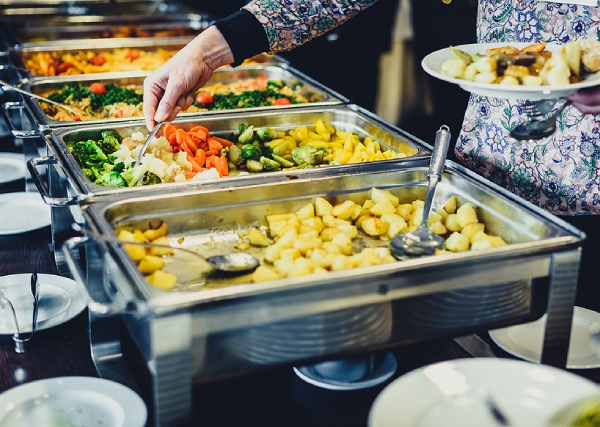
Chafing dishes, serving spoons, tongs, platters, and warming trays – all of this equipment needs to come from somewhere. If your venue doesn’t supply it and your caterer doesn’t include it in their standard package, you’ll be hiring it separately.
The same goes for tableware. Plates, cutlery, serving bowls, and even napkins can be line items on a catering invoice that clients don’t anticipate. Some caterers bundle this in; others treat it as an add-on.
It’s worth asking specifically:
- What tableware and serving equipment is included in the quote?
- Is linen hire (table covers, napkins) covered?
- Are there delivery or collection charges for equipment?
This is especially relevant if you’re exploring contemporary or fusion buffet trends, where presentation and serving vessels are a key part of the experience and may require more specialised and more expensive equipment than a traditional spread.
3. Dietary accommodations and menu customisation
Singapore has a wonderfully diverse food culture, and any sizable guest list is likely to include people with a range of dietary needs, such as halal requirements, vegetarian or vegan guests, those with nut or shellfish allergies, and so on.
Meeting these needs is absolutely the right thing to do, but it can affect your costs. Specialised ingredients, separate preparation areas to avoid cross-contamination, and additional labour for custom dishes can all add to the bottom line. According to the Singapore Food Agency, food businesses operating with halal certification must meet specific preparation and handling standards, which means certified caterers invest in separate processes that are reflected in their pricing.
The smart move is to get a rough headcount of guests with specific dietary needs before you finalise your menu, and ask your caterer how they handle and price these accommodations.
4. Location, venue, and timing surcharges
This is where a lot of budgets get quietly stretched because surcharges tied to where and when your event takes place are genuinely easy to overlook.
CBD surcharges are one example. If your event is in the Central Business District, many caterers apply an additional delivery or logistics fee. Parking in the CBD is expensive, loading and unloading is restricted in certain areas, and navigating peak-hour congestion adds time and cost to every delivery. It’s a legitimate operational reality, but it’s not always flagged clearly in an initial quote. If your venue sits within the CBD, ask your caterer directly whether a location surcharge applies.
CNY and public holiday surcharges are another one to watch. Catering during Chinese New Year, Deepavali, Hari Raya, Christmas, or on any gazetted Singapore public holiday typically costs more. Staff are entitled to higher pay on public holidays under the Employment Act, ingredient supply chains can be disrupted during festive periods, and demand spikes dramatically, all of which push prices up. Some caterers apply a flat surcharge; others reprice the entire menu. Either way, if your event falls on or near a public holiday, factor this in from the start rather than being surprised when the revised quote arrives.
Beyond these, some venues charge caterers a kitchen access or facility fee. Others have preferred supplier lists, and using an outside caterer may trigger a surcharge. If you’re supplying your own drinks and the venue has a bar licence, there may be a corkage fee per bottle.
Before you book anything, ask your venue:
- Do you charge caterers a facility or kitchen access fee?
- Is there a preferred supplier arrangement, and what are the implications of going outside it?
- What is your corkage policy?
It’s also worth checking whether NEA guidelines around food hygiene and licensing affect how external caterers can operate at your chosen venue. Some venues factor compliance costs into their external catering policies.
5. Wastage buffers and minimum order requirements
Caterers don’t prepare exactly the number of portions you’ve ordered. They build in a buffer (typically 10–15%) to account for guests who take larger servings, popular dishes that go quickly, and general unpredictability. This is standard practice and genuinely protects your event from running out of food halfway through.
However, it does mean you’re paying for more than the headcount implies. If you ordered for 80 guests, you may be charged for portions closer to 90. On top of this, many caterers have minimum order thresholds. If your guest count is below that threshold, you may still be billed at the minimum, which can feel like poor value for a smaller gathering.
Ask your caterer what their standard wastage buffer is, how it affects pricing, and whether there’s a minimum order that applies to your event size. A transparent caterer will explain this clearly before you sign anything.
A few other costs worth keeping in mind
Beyond the five above, there are a handful of smaller items that can add up:
- GST: Currently at 9% in Singapore, this applies to most catering services and isn’t always displayed prominently in initial quotes.
- Last-minute changes: Adding guests, swapping menu items, or changing the event time close to the date often incurs an admin or repricing fee.
- Parking and delivery surcharges: For venues with difficult access or paid parking, delivery fees may be higher than expected.
Conclusion
Budgeting for catering is about understanding everything that goes into delivering a smooth, well-fed event. The caterers who give you the clearest picture upfront, including the parts that cost extra, are the ones worth working with.
At Eatz Catering, we believe in transparent, no-surprise pricing from the very first conversation. Whether you’re planning an intimate corporate lunch or a large-scale celebration, our team will walk you through exactly what’s included, what’s optional, and what you can expect to pay in total, so you can plan with confidence. Get in touch with us today to discuss your event and find out how we can make your next catering experience seamless and right on budget.